"What, then, is this material world? Of what does it consist?"
So asks Tim Ingold, in his book, Being Alive, Essays on Movement, Knowledge and Description. It seems an obvious question, or rather, a question for which there is an obvious answer, but in terms of the field Material Culture it would seem to be not so straightforward. Citing a number of works on the subject, Ingold writes how "their engagements, for the most part, are not with the tangible stuff of craftsmen and manufacturers but with the abstract ruminations of philosophers and theorists." Furthermore, "literature in anthropology and archaeology that deals explicitly with the subjects of materiality and material culture seems to have hardly anything to say about materials." Ingold then goes on to cite an inventory of materials one might expect to see when dealing with this subject, as can be found in a book by Henry Hodges called Artefacts.
pottery glazes glass and enamels copper and copper alloys iron and steel gold, silver, lead and mercury stone wood fibres and threads textiles and baskets hides and leather antler, bone, horn, ivory dyes, pigments and paints adhesives
In an array of books on his bookshelf, all dealing in some form with the subject of material culture, Ingold states that one looks in vain for any "comprehensible explanation of what 'materiality' actually means, or for any account of materials and their properties." To cut a long story short, Ingold goes on to question what the material world actually is - thus the question at the top: "What, then, is this material world? Of what does it consist?"
He writes:
"Christopher Gosden suggests, we could divide it into two broad components: landscape and artefacts. Thus it seems that we have human minds on the one hand, and a material world of landscape and artefacts on the other. That, you might think, should cover just about everything. But does it? Consider, for a moment, what is left out. Starting with landscape, does this include the sky? Where do we put the sun, the moon and the stars? We can reach for the stars but cannot touch them: are they, then, material realities with which humans can make contact, or do they exist only for us in the mind? is the moon part of the material world for terrestrial travellers, or only for cosmonauts who touch down on the lunar landscape? How about sunlight? Life depends on it. But if sunlight were a constituent of the material world, then we would have to admit not only that the diurnal landscape differs materially from the nocturnal one, but also that the shadow of a landscape feature, such as a rock or tree, is as much a part of the material world as the feature itself. For creatures that live in the shade, it does indeed make a difference! What, then, of the air? When you breathe, or feel the wind on your face, are you engaging with the material world? When the fog descends, and everything around you looks dim and mysterious, has the material world changed, or are you just seeing the same world differently? Does rain belong to the material world, or only the puddles that it leaves in ditches and pot-holes? Does falling snow join the material world only once it settles on the ground? As engineers and builders know all too well, rain and frost can break up roads and buildings. How then can we claim that roads and buildings are part of the material world, if rain and frost are not? And where would we place fire and smoke, molten lava and volcanic ash, not to mention liquids of all kinds from ink to running water? ... If, moreover, they are part of the material world, then the same must be true of my own body. So where does this fit in? If I and my body are one and the same, and if my body indeed partakes of the material world, then how can the body-that-I-am engage with that world?"
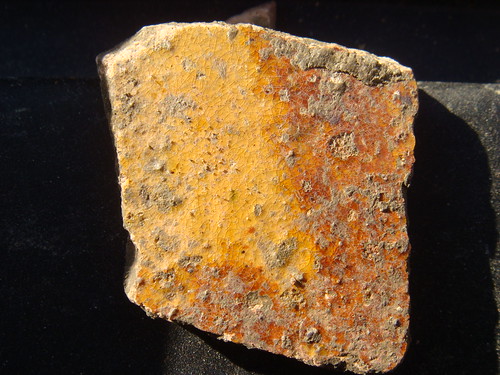
When I read this, I thought about the dig I went on last year at Bartlemas Chapel in Oxford, when I found a small but rather beautiful piece of mediaeval (I think) pottery.
There are many ways in which one could interpret this find, but what I thought about was how this was like a missing piece of the present, and how, before it was lost to the soil, it had existed in a mediaeval present that was (save for the obvious differences) just like ours today. There was the wind, there were trees and flowers, the clouds, the sky and of course the sun, by whose light the beautiful glaze could be seen again, just as it had been by someone living hundreds of years ago. Reading what Tim Ingold has written about materiality and material culture above therefore made perfect sense.
And as regards my work with empathy and the importance in this respect of materiality and material culture, the idea of the body as part of the material world was also of interest. We are not set outside the material world but are an integral part - therefore it's easier to engage empathetically with an individual through the objects those individuals once used. Empathy is as I've said before an augmented discourse between bodily experience and knowledge. Knowledge as Ingold writes derives through movement: "It is by moving that we know, and it is by moving, too, that we describe." When I discovered the piece of pottery (through moving), I uncovered not only the object itself, but the material world by which it was once surrounded, including those people who once used it, or the person who even made it.
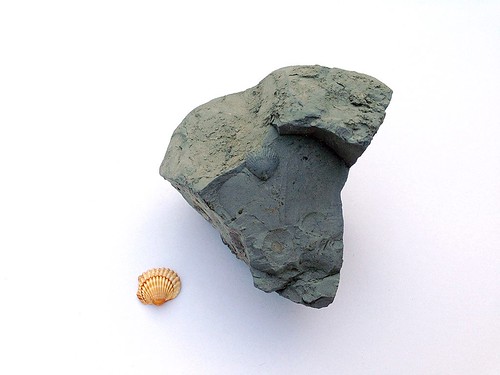
The object is a lump of soft grey rock. It is irregular in its appearance except for a small part about 1cm square, which is extremely regular in its form. The piece of rock is heavy and feels quite dense and sits comfortably in the palm of my hand. If I scratch the surface with my finger nail a mark is left behind. The texture of the piece of rock is rough but at the same time its softness makes it feel quite smooth to the touch. Part of its surface is smoother than that on the other side and it is on this side I can see the regular pattern of lines and a couple of other circular imprints. This smooth part of the rock feels softer than that on the outside - indeed there seems to be a distinction between an outside and an inside. The inside is defined in some respects by what looks like a cut. The ridge is about a centimetre deep and is irregular in shape, although it seems, compared with the other side, more regular.
The very distinguishable pattern is a shell. I can see the ridges running from its outer edge at the top to the bottom. There also seems to be a dark patch running from one side to the other about a third of the way down from the top. There is a distinguishable bulge at the bottom of the shell where all the lines meet.
The rock feels cool but not cold (as I write my observations outside in the garden, a breeze is blowing, turning the pages and agitating the protective wrappings in which I keep the rock). Looking carefully at the surface of the rock, on what I have called its outside, I can see small patches of grey which unlike the rather dull complexion of the rock are quite shiny, reflecting the light of the evening. The rock seems encrusted with crumbs of rock which it seems I could easily rub off with my thumb.
The rock has about nine surfaces or faces including the ridge mentioned earlier and the face on which you can find the form of the shell. Whereas the crumbs of rock and the lines, imprints and grey shining patches seem an integral part of the rock; the shell-like form seems (although it is made of the same thing) separate somehow. It is both the rock and something entirely different.
As the wind blows a little, everything moves it seems, save for the rock (and the table on which it is resting). It feels in my hand extremely fragile, as if should I drop it, it would break apart. Certainly I feel as if I could break pieces off with my bare hands.
Although to the eye there are faces of the rock which seem rough and those which seem much smoother, it feels nonetheless as I hold it in my hand the same texture all over. It has in some respects the look of a piece of bone (like a hip joint) or a worked piece of stone - an ancient tool for example. As I write I can hear the odd shout in the street.
Part 2
The piece of rock is a fossil found in a large piece of rock next to cliffs at Charmouth. The rock is dated to around 195 million years old. The whole of this piece of rock has therefore been part of an inside for a period of time that is unimaginable in my human brain. It was once part of the cliff and therefore one can imagine that it would have been under a great weight. Of course the piece of rock only became a piece of rock because the cliff face eroded. Then part of the face collapsed, a smaller piece was broken open and inside the shell was revealed. For much of its incredible life span then, it wouldn't have been a piece but rather a whole. And, therefore, this piece wouldn't have born the whole weight of the cliff upon its shoulders; this weight would have been distributed throughout the layer of which it was a part.
The shell would, like the rest of the rock, have been covered (surrounded by 'other rocks'). It is the breaking open of it which gives it a sense of being 'inside'. Imagining it surrounded by rock, a seamless expanse of rock, one does have a sense of darkness and a sense of weight - immense dark and immense weight. When I found it and broke it open, there was, suddenly the sense of lightness and indeed light, whereupon the pattern of the shell's form was revealed for the first time in over 195 million years.
The light from the sun in the present day allows me to see the lines - the same sun that would have shined above the sea 195 million years ago.
This sense of an outside and an inside: the inside is hidden from view - invisible, and yet it exists. Looking at a cliff one sees colossal weight, density and reaching my eyes inside, I can picture only darkness. And yet, looking at this rock, one sees a form which is fragile, delicate, regular, light. The cliffs must be full of such tiny shapes - full of fragility; a delicate, lightness of touch. This mirrors the time before the rock was formed, when the shell was a living creature in the seas. One can imagine the light of the sun on the sea, the lightness of the creature - its fragility as it lived. There is a sense of the sea being light (in terms of sunlight and a lack of weight) and yet the sea is also impenetrably dark and heavier than the cliffs which we see today.
(The cliffs are little different then to the sea. They are not static, but are moving, slowly - too slow for our eyes until the second they slide.)
The shell would have been compressed on the sea floor over tens of thousands, hundreds of thousands, millions of years. Its outline, its shape, its ridges and perhaps its surface pattern were fixed as lines of incredible delicacy. The sea levels fell, the rocks shifted: huge, unimaginable forces, acting over vast, incomprehensible spaces of time - and yet this shape and these lines have remained. And all the while these lines have existed - this tiny shape has existed, whole epochs have come and gone - creatures have evolved ; whole species, including the dinosaurs have come and gone; the great mammals and so on. And finally man has evolved too. There is the sense that I'm looking only at the shell rather than the rock of which it is a part.
This lump of 'unremarkable' rock, shapeless, rough, grey, ugly, is just as ancient and incredible as the beautiful, perfect shell which is a small part of it.
Part 3
Movement. Frozen. The individual object which is not a part but a whole. Air, light, water, colour condensed to make this soft, grey mass. Delicacy of life translated into the delicacy of the small pattern on the rock's surface. (The light fades outside where I write and the shape of the shell begins to dissolve into the rock). Movement of the shell. Movement of continents. Movements of creatures, of time on an evolutionary scale. The weight of time which this patten of lines has withstood for 195 million years. (What can humans withstand as individuals and as a species?) (Colours begin to face into darkness).
Part 4
Movement returned to the rock from the moment it was found and carried in my hand - carried into the garden this evening. Movement of that creature, of everything that sank to the seabed, of the water above, whose weight pressed upon it - now becomes/joins with my own movement through time/this world. The light that allows me to see the lines of the shell - its shape, eyes which would have evolved since that shell was in the sea. The delicacy of light, of eyes. Lightness. Weight. Pressure. Light. Vision. Lines.



0 comments: